
New Single from 8th Day “Hakhel”
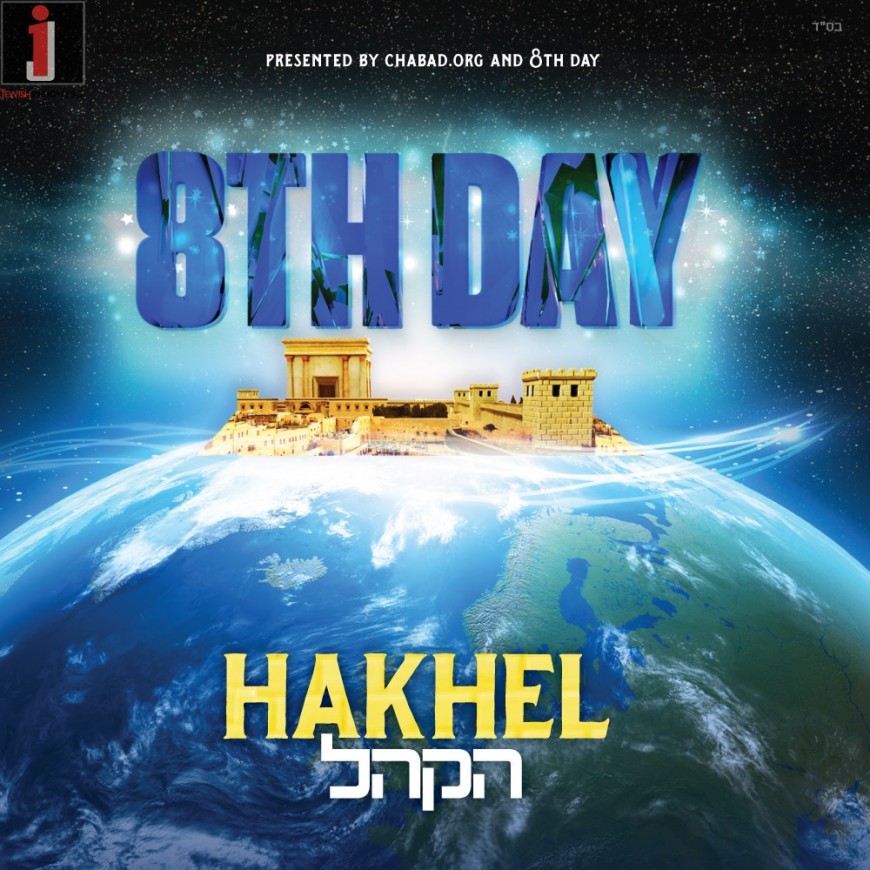
A project of Chabad.org and 8th Day
Written and composed by Shmuel Marcus
Produced and arranged by Bentzi Marcus
Instrumentation, clarinet, sax and synth arrangements by Leo Chelyapov.
Mix and master: Matt Thorn
Cover design: Sruly Meyer
Special thanks to Chabad.org and entire
staff.
In the ancient times of the Beit Hamikdash (the Holy Temple in Jerusalem,) every 8th year was considered a year of “Hakhel” (“gathering/unity”) and the entire Jewish nation would gather together to hear the Torah read by the king of Israel on the Temple Mount. It was a time to reconnect and recommit to G-d and the Torah and was therefore a commandment for all, “men, women and children.” Young and old alike.
The Chabad Rebbe encouraged all to participate in the special year of “Hakhel” although we don’t have the Holy Temple in Jerusalem. Any type of event or opportunity to gather together in Jewish unity, large or small.
And through this year of “Hakhel” may we merit to have the rebuilding of the Beit Hamikdash with the coming of Moshiach speedily in our days!!
Available to preview and purchase: https://mostlymusic.com/products/8th-day-hakhel

Related Articles

“Lizro’ach Kimo Ani-To Shine As I Am”Eliyahu Rafael Kain Releases A New Single Dedicated To The “invisible” People
Singer-songwriter Eliyahu Rafael Kain has launched a new single titled “Lizroach” (“To Shine”)—a song centered on self-belief, discovering one’s inner

The Tzitzit In The Operating Room That Inspired A Song: Yisrael Goldreich Releases A New Version of “K’nesher”
At the age of seven and a half, following a fall that resulted in a complex fracture, Yisrael Goldreich was

Four Voices & One Choir: Akiva Gruman Hosts “Chevraya” For The Major Production “Hoshana Rabbah”
Following a string of successes that have become staples of Chassidic music—such as “Kiddush,” “Shalom Zachar,” and “Rosh Chodesh”—Akiva Gruman
